Tuesday, April 5, 2011

Dreams of Trespass

Have you ever read a book that gripped you so completely that you not only revisited it many more times, but begin to view it as a friend? I was thirteen when I stumbled across Fatima Mernissi's Dreams of Trespass in the biography section of my local library, and it instantly became a favorite that I checked out many more times before caving and actually buying it a few years later.


Dreams of Trespass is Mernissi's memoir of her childhood in Fez, Morocco around the second World War. Funny, fascinating, and extremely informative, she describes her family harem as both a prison and a refuge, and compares it to her grandparents' lives up in the mountains.
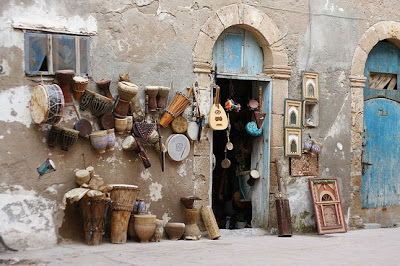


As a child, Mernissi is sent to school to learn hudud, the sacred frontiers. But soon she, and we as her readers, begin seeing frontiers everywhere. She is a child looking at an adults' world, a female looking at a men's world, and a Moroccan looking at a European world. Yet her description of it all is done in a delightfully adroit manner and in a child's voice. Her take on Germans:

The Allemane (Germans) were Christians, that was for sure. They lived in the North like all the others, in what we call Blad Teldj, or the Snowland . . . To warm themselves up, they had to drink wine and other strong beverages, and then they goat aggressive and started looking for trouble.

And the English:

Cousin Zin, who had visited England, said the tea up there was so bitter, they mixed it with milk. So Samir and I poured milk into our mint tea once, just to give it a try, and it was ugh! awful! No wonder the Christians were always miserable and looking for fights.


This was the book that inspired me to read as much as a I could about Morocco, with the knowledge that one day, I would go. And when I finally did, I wondered about hudud, and how they had changed since Mernissi was a girl.


All images via here.

Thursday, March 17, 2011

St. Patrick's Day

Cast your mind on other days
That we in coming days
May still be the indomitable Irishry
~ W.B. Yeats

A few years ago I met an Irish man in Poland who asked if I was Irish-American. "Because," he said, "I have yet to meet an American who isn't." It's true that Americans with Irish blood are inordinately proud of it, and those without . . . sort of wish they were. Today St. Patrick's Day parades and festivals across the USA rival those in any other country, including Ireland!


I know that I was entranced by Ireland's history and culture from a very young age. When my fourth grade classmates listened to Mariah Carey, I was busy with the Chieftains. I found an excuse to write a paper on Ireland nearly every year throughout high school and college, whether it was on the famine, the Book of Kells, or Seamus Heaney's poetry. And then there was that time when I was twelve and tried to speak in an Irish brogue for about a week. (Hint: it's a great way to alienate family and friends!)


But St. Patrick's Day is more than just about Irish pride and downing as much Guinness as humanly possible; the fifth century in Ireland was witness to something rare in history: mass conversion without bloodshed. Patrick gathered his followers by incorporating their beliefs into his own. 


Religious intolerance seems to be at a peak lately all over the world, and I find hope in St. Patrick's work, that one religion can work with another without violence. So I ask readers to take a moment to wish that religious leaders globally spread messages of cooperation and peace. Now go get that Guinness. 


Tuesday, March 15, 2011

Prayers for Japan

Oh, the foot-drawn trail
Of the mountain-pheasant's tail
Drooped like down-curved branch!
Through this long, long-dragging night
Must I lie in bed alone?
~ Kakinomoto No Hitomaru

The natural, and now nuclear, disaster in Japan is tragic to follow. Devastation of this magnitude leaves us with questions: How will the survivors recover? How will Japan as a country recover?


Perhaps the best part of globalization is how quickly both knowledge and relief can travel. Clotilde over at Chocolate and Zucchini has some wonderful tips on how to help. Through aid and expressions of sympathy and compassion, it is vital to let the people affected by this tragedy know that they are not alone.

Friday, March 11, 2011

Sakura and Hanami: Festival of Spring

Nothing says spring quite like a blooming cherry tree. The delicate color, sweet scent, and over-all abundance of these flowers are beloved anywhere they bloom, but especially in Japan. Here their ephemeral beauty both embodies and symbolizes mono no aware, a term which refers to a wistful awareness of the transience of things. The cherry blossom (called sakura) is used as a motif in textiles and household goods, in folk and pop songs, and even in anime!


Every year there is a natural watch and forecast of the cherry trees blooming. Then there are festivals called Hanami, where families and friends picnic under the trees. Apparently, the custom of Hanami dates back to the third century AD! I love this idea of looking forward to and appreciating such a short and seasonal beauty. 


Luckily, there are cherry blossom festivals all across the U.S. as well. And even if there isn't, there is nothing stopping you from finding a blooming tree in a park to picnic under. To give your picnic Japanese flavor, bring miso soup in a thermos and these rice balls. Don't forget the sake!


Wednesday, February 23, 2011

That Summer in Sicily


To continue Monday's imaginary jaunt to southern Italy (and in complete defiance of the snow outside my window), I'm deciding to move on to the isle of Sicily. The name usually conjures up images of mafiosi, and while their prevalence and history is definitely one facet of the fascinating region, it certainly isn't the only one.


 Images via here and here.

 Marlena de Blasi is the author of A Thousand Days in Venice and A Thousand Days in Tuscany, neither of which I've read. They are now on my list, however, after enjoying That Summer in Sicily, a beautiful account of how the author and her husband stumble upon a mysterious villa, and learn of the love story of its patroness.


De Blasi's writing is sensual and earthy, and she describes things in intricate detail. For instance, read how she illustrates her hostess as she prepares a drink.

From her high-backed white iron chair with the red velvet cushion, she tugs at the less regal one next to her and beckons me to sit. I do. An assent. Into a thin, tall glass she pours out a cloudy stream of almond milk from a small pitcher, adds water from another pitcher, unscrews what looks like a medicine bottle, and with a dropper, doses the whitish mixture with a few drops of neroli. Essance of orange blossoms. She stirs the drink with a long spoon, stirs it ferociously, removes the spoon, and lays it, bowl down, upon the table. A high priestess in full ceremony, her movements seem liturgical.

A recipe I may have to try myself . . .

Monday, February 21, 2011

Travel Through Dance: The Tarentella in Caulonia

Dance and music allow travelers to simultaneously experience the uniqueness of a place while emphasizing the basic human need for rhythm and movement. Can you really claim to have experienced a place's culture and people without having moved with them?


There are so many locations in the world that have their own variants of song and dance. In southern Italy, it is the Tarentella.


Although the image above is rather picturesque, the Tarantella has a grim past. It gets its name from the tarantula (which, in turn, is named after the region of Taranto) and has more than one story of its origins. The first is that the bite of a tarantula drives its victim to manic dancing, perhaps an explanation of the dance madness that swept across Europe in the Middle Ages. Another version is that when a person was bitten, he or she would frantically dance for hours to prevent the poison from leading to death.


A slightly gruesome and completely fascinating history still leaves its mark today. The Tarantella can be danced solo as a type of healing process and is used in therapy for depression and other ailments. It can also be danced for fun as a couple or group, simulating sword fights or courtship.


Both the music and the dance is still a part of the culture today, as evidenced by this talented group of ragazzi!


The Tarantella Festival takes place in Caulonia (or Kaulonia) in late August every year, and attracts thousands of visitors and Tarentella enthusiasts. Caulonia is a rocky municipality in southern Italy with beautiful cliff vistas, narrow twisting streets and greek ruins. 


Exploring southern Italy is definitely on my trip wish list, but I would definitely like to visit Caulonia in time for this festival!